Plastic Free Tea Packaging
Plastic-free tea bags, and a very long argument about glue
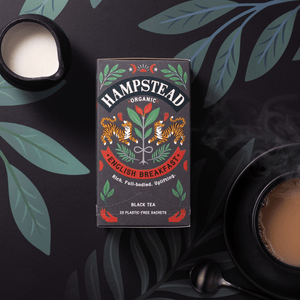
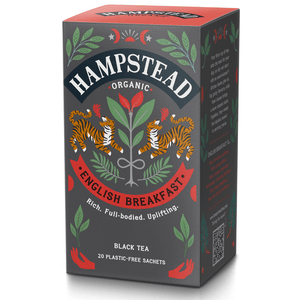
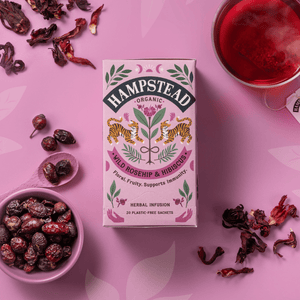
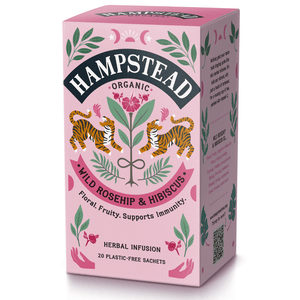
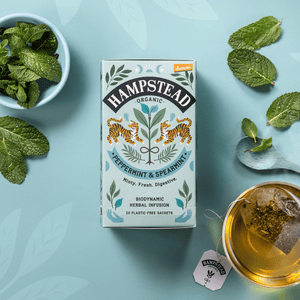
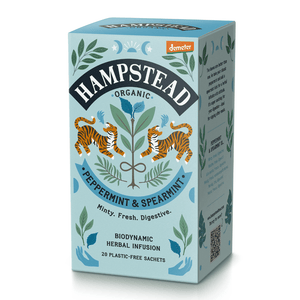
There's no plastic in a Hampstead tea bag. There never has been.
Ours are unbleached paper, stitched shut with cotton thread, with organic tea inside and nothing else at all. No plastic heat seal, no plastic mesh, no PLA. It's the thing people ask us about more than anything else, so here's the whole answer.

Why plastic ends up in tea bags at all
Most tea bags are sealed rather than stitched, and a seal needs something that melts. Usually that something is plastic, or a plastic-adjacent polymer like PLA, and it's there because it runs fast on a production line rather than because anybody thinks it improves the tea.
The trouble is what happens next, which is that you pour boiling water over it. In 2019 a team at McGill University brewed a single plastic tea bag and counted what came out: an estimated 11.6 billion microplastic particles, from one cup. It's peer-reviewed, and we've linked it at the bottom.
We're not going to wave a frightening number around and leave you to it. But nobody has ever made much of a case for drinking plastic. We'd rather not have microplastics in our bodies and we assume you feel the same, and that's about as scientific as we need to get about it.

Why we've been like this from the start
Kiran moved to London from India in 1986 and spent months failing to find a tea that was honestly made. Then she met Rajah Banerjee, who ran a garden called Makaibari up in the Darjeeling hills, and he told her there were no nasties in his soil. She organised its organic certification herself the following year, because it turned out nobody else in Darjeeling had bothered.
Plastic-free packaging is the same argument further along the line. There's not a lot of point being fastidious about what goes on the leaf and then wrapping the whole lot in plastic.
And why wrap each bag individually?
We pack our tea bags in paper sachets because it's the only way to keep tea away from moisture. Most of us have our tea boxes right above the kettle, which is the steamiest spot in the house, and tea is hygroscopic. Long word, simple idea: it drinks in whatever's around it meaning the flavour will dissipate into the moisture, and when you finally go to make the tea, it's not quite as you expected. We also need to protect against smells, flavourings in the kitchen; after all a delicate Darjeeling first flush tea doesn't want to be tasting like last night's Thai chicken curry!
Many tea bags are wrapped in plastic to avoid this, but we're against putting plastic in, or around, our tea. Our paper bags quite simply are another layer of protection against the external atmosphere and to make sure your tea tastes just as we intend it.

The clear wrapper is plastic-free too
Loose leaf is a harder problem. It needs a wrapper that keeps moisture out for months, and for a long time the only material that managed it was plastic film.
Then NatureFlex arrived. It's wood pulp from FSC-certified forests, turned into cellulose (the same natural polymer plant cell walls are made of) and cast into a thin, clear film. It looks like plastic film and behaves like plastic film without being plastic. Transparent paper, essentially. And because it's cellulose rather than plastic, it's certified home compostable — the empty wrapper can go straight in your garden compost bin. It costs us more, the tea keeps just as well, so there wasn't a great deal to decide.

The catering bags, and the glue
Cafés ask us about the 1kg bags, usually while peering suspiciously at the inside of one. The outside is obviously paper. The lining is the question, and it's cellulose again with a fine metallised layer, made from wood pulp rather than plastic, keeping air and moisture out so the tea is still worth drinking weeks after you opened it.
Then there's the glue. We spent a genuinely unreasonable amount of time on the adhesive that holds that lining in place, because you can build an entirely plastic-free bag and then let the whole thing down with a bit of ordinary glue nobody will ever see. Ours is compostable. Not one person has ever mentioned it. We think about it constantly.

It all composts
Tea leaves are full of nitrogen and break down fast in a compost heap, which means everything wrapped around them has to keep pace or you're left with intact packaging and no tea.
One last thing
None of this makes the tea taste better, which is an odd thing to admit at the bottom of a page about packaging.
What it does is make sure nothing gets between you and the tea. No plastic in the bag, no plastic in the wrapper, no microplastics in the cup. That's the entire job of a tea bag, and it's a shame how often it's the bit nobody thinks about.
Thirsty for more?
Where this comes from
Hernandez et al. (2019), Environmental Science & Technology, McGill University. https://pubmed.ncbi.nlm.nih.gov/31552738/
Futamura Group, NatureFlex material and certification information. https://www.futamuragroup.com/products/natureflex/